
If you buy through affiliate links, we may earn commissions, which help support our product reviews.
Last Updated: Mar 11, 2026
If you travel with dogs or cats, one of the biggest questions is simple: how do you monitor RV temperature for pets when you do not have reliable WiFi? That matters because campground WiFi can be weak, hotspots can lose power, and many RV owners do not want to depend on a phone being left behind in the rig. If you want real remote alerts when you step away for lunch, groceries, or an attraction, you need a setup that still works when WiFi does not.
This guide explains what an RV pet temperature monitor with no WiFi actually means, which features matter most, and which setup makes the most sense for pet safety. We will also cover why temperature alone is not enough if you want true peace of mind.
Quick answer
If you want remote alerts without WiFi, you need a system with cellular connectivity or a hub that supports cellular failover. For RV pet safety, the best setups usually include:
- temperature and humidity monitoring
- power-loss alerts
- backup power or battery awareness
- app, text, or email alerts
- reliable connectivity when campground WiFi is unavailable
Why “no WiFi” matters more than most RV owners expect
Many RV owners start with a simple assumption: “I already have a hotspot, so I can just use a WiFi monitor.” Sometimes that works. But pet safety is the wrong place to rely on a single fragile link.
Here is the real problem. A hotspot can run out of power, overheat, disconnect from the network, or end up in a weak-signal area. Campground WiFi can be overloaded. If the RV loses shore power, your internet path may disappear at the same time the air conditioner stops working. That is exactly when you need alerts the most.
That is why so many buyers specifically search for an RV pet temperature monitor no WiFi rather than a generic indoor thermometer. They are not only trying to read temperature. They are trying to solve one bigger problem: getting a warning in time to act.
What “RV pet temperature monitor no WiFi” usually means
In practice, buyers are usually looking for one of these three setups:
- A self-contained cellular monitor. This is the simplest option. The device has its own cellular connection and sends alerts directly.
- A local RV hub with optional cellular failover. This is more flexible. The hub collects data from sensors inside the RV and can use WiFi when available, with cellular backup for alerts.
- A WiFi-only monitor. This can work if your RV always has dependable internet, but it is not the best answer for people specifically searching for “no WiFi.”
The right choice depends on how you travel. If you boondock, move often, or leave pets in the RV during stops, a cellular path is usually the safer answer. If you already want a full monitoring system for temperature, battery voltage, shore power, and door alerts, a hub-based system can make more sense.
The 6 features that matter most for Pet Safety
Not every RV pet monitor is built the same. These are the features worth prioritizing before price, app screenshots, or marketing claims.
1) Remote alerts without depending on campground WiFi
If your main goal is pet safety, the monitor should still alert you when the RV has no usable WiFi. That usually means built-in cellular or cellular backup.
2) Power-loss alerts
Temperature is only half the story. Many RV emergencies start with lost shore power, a tripped breaker, or an air conditioner shutting down. A strong system should tell you why the cabin is heating up, not just that it already has.
3) Fast temperature updates
You want frequent readings and alert thresholds you can actually control. For example, some owners may want an early warning at 78°F while others may choose a different threshold based on breed, weather, and AC performance.
4) Battery or power awareness
A better RV monitor can also watch your 12V system. That helps you catch low battery conditions, charging problems, and power events that might affect your pet monitor itself.
5) Backup operation during outages
If the RV loses power, the monitoring device should keep working long enough to send the alert. A monitor that dies at the same moment the AC dies is not much help.
6) Clear app history and simple setup
When you check the app, you should be able to see current temperature, recent history, and whether the issue is power, connectivity, or environment. Simple setup matters too. If it takes an afternoon of troubleshooting, most owners will never trust it.
Best setup types for RV pet monitoring without WiFi
| Setup type | Best for | Main advantage | Main downside |
|---|---|---|---|
| Cellular-only monitor | Owners who want the simplest no-WiFi solution | Works independently of campground WiFi | Usually adds a monthly plan |
| Hub + cellular failover | Owners who want more than just temperature | Can monitor temp, power, battery, sensors, and remote alerts | Usually more hardware upfront |
| WiFi-only monitor | Owners with very stable internet in the RV | Can be cheaper to operate | Not ideal for the “no WiFi” problem |
Option 1: Cellular-only monitor
This is the easiest answer if your only goal is pet temperature alerts. You plug it in, activate service, set alert thresholds, and monitor through the app. It is the cleanest fit for travelers who do not want to manage an RV network.
Choose this route if you want simplicity over expansion.
Option 2: Local hub with optional cellular failover
This is the better fit if you want your RV monitor to do more than temperature alone. A hub-based system can combine temperature sensors, battery voltage, shore power awareness, and additional sensors such as door or leak alerts. It can use WiFi when available, but still send critical alerts over cellular failover when the normal internet path is down.
That approach can be more useful for RV owners because it solves multiple failure points at once: cabin temperature, power events, and connectivity loss.
Option 3: WiFi-only RV monitor
A WiFi-only monitor can still be useful if you mostly stay where internet is stable and you only need occasional remote access. But if your search started with “no WiFi,” this is usually not the answer you were really looking for.
What we recommend for most RV pet owners
If your top priority is the simplest remote pet safety setup, choose a cellular monitor.
If your priority is pet safety plus power and RV monitoring, choose a hub-based system with optional cellular failover. That gives you a more complete picture of what is happening inside the RV and can reduce false confidence from temperature-only monitoring.
For many RV owners, the ideal setup looks like this:
- 2 indoor temperature/humidity sensors
- battery voltage or power monitoring
- remote alerts by app, text, or email
- local dashboard inside the RV
- cellular failover for critical alerts
That way, you are not betting your pet’s safety on one hotspot, one campground router, or one AC cycle.
Do you need more than temperature?
In many cases, yes. A true pet safety setup should answer four questions:
- Is the RV getting too hot or too cold?
- Did shore power fail?
- Is the 12V system still healthy?
- Will I still get the alert if WiFi fails?
If a device only answers the first question, it may still be useful, but it is not a complete safety system.

Trakkit Option: a Hub-based RV monitor with optional Cellular backup
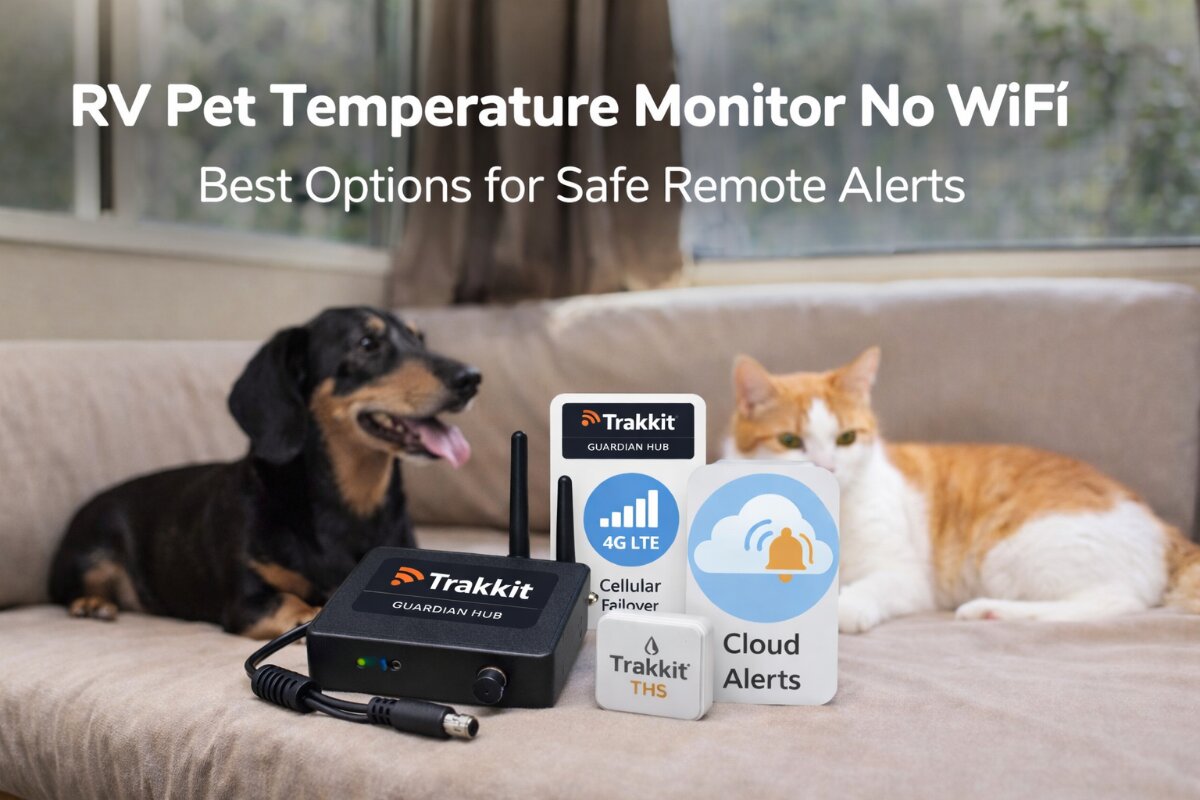
If you want one system that can combine temperature monitoring, battery awareness, local history, and remote alerts, take a look at the Trakkit Guardian Hub. It is designed for RV owners who want a more complete monitoring setup instead of a single-purpose indoor sensor.
Pair it with Trakkit THS sensors for indoor temperature and humidity monitoring, then add the connectivity level that fits how you travel:
- Local / WiFi plan for basic access when your RV has internet
- Cloud Alerts plan for app history and remote notifications
- Cellular Failover plan for backup alerts when WiFi is down
- Cellular Primary plan for owners who want a true no-WiFi setup
FAQ: RV Pet Temperature Monitor No WiFi
Can I monitor my RV temperature for pets without WiFi?
Yes. You need a monitor with built-in cellular connectivity or a hub that supports cellular failover. Without one of those, remote alerts usually depend on WiFi being available and working.
Is a hotspot good enough for an RV pet monitor?
A hotspot can work, but it is not the most dependable choice for pet safety. It can lose power, overheat, disconnect, or fall out of coverage. Many owners prefer a monitor with its own cellular path or at least cellular backup for alerts.
What is the best RV pet temperature monitor with no WiFi?
The best choice depends on your use case. If you want the simplest setup, a cellular monitor is usually best. If you want broader RV monitoring, a hub with sensors and optional cellular failover is often the better long-term solution.
Do I need power-loss alerts too?
Yes, power-loss alerts are highly recommended. Temperature tells you what is happening inside the RV, but power alerts often tell you why it is happening and can give you earlier warning.
Can one system monitor both pet temperature and battery voltage?
Some systems can. That is one of the biggest advantages of a hub-based RV monitor over a single-purpose temperature device.
Bottom line
If you are searching for an RV pet temperature monitor no WiFi, what you really want is dependable remote alerting when you are away from the rig. For that, built-in cellular or cellular failover matters more than fancy app graphics or extra marketing features.
If you only need simple monitoring, choose a cellular device. If you want a more complete RV safety setup with room to expand, choose a hub-based system that can monitor temperature, power, and battery status in one place.